The Hidden Risks of Giving Multiple Employees Website Access
Your Website is More Complex Than You Realize
Many business owners assume that giving multiple employees access to their website will help them publish more content, keep information current, and reduce the workload on marketing staff.
In reality, the opposite often happens.
While your employees may be experts in engineering, construction, HR, accounting, healthcare, manufacturing, or operations, that expertise does not automatically translate into effective website management, content marketing, SEO, branding, or digital strategy.
A website is not simply an online brochure. It is a business development tool, a sales tool, a brand asset, and often the first impression a potential customer receives.
When too many people are allowed to make changes without proper training, consistency, oversight, or strategy, websites can quickly become disorganized, ineffective, and difficult to manage.
The “Everyone Thinks They Know Marketing” Problem
Marketing is one of the few professions where people regularly assume expertise without formal training.
Most people have:
Posted on social media
Uploaded photos
Written emails
Used Canva
Read marketing articles online
As a result, many believe they understand digital marketing.
The reality is that professional marketing combines strategy, psychology, branding, user experience, SEO, analytics, conversion optimization, content development, accessibility standards, and technical website management.
When ten different people contribute content, each person brings their own opinions, preferences, and assumptions.
Soon, your website becomes a collection of individual ideas instead of a cohesive marketing asset.
Common Mistakes Employees Make When Posting Website Content
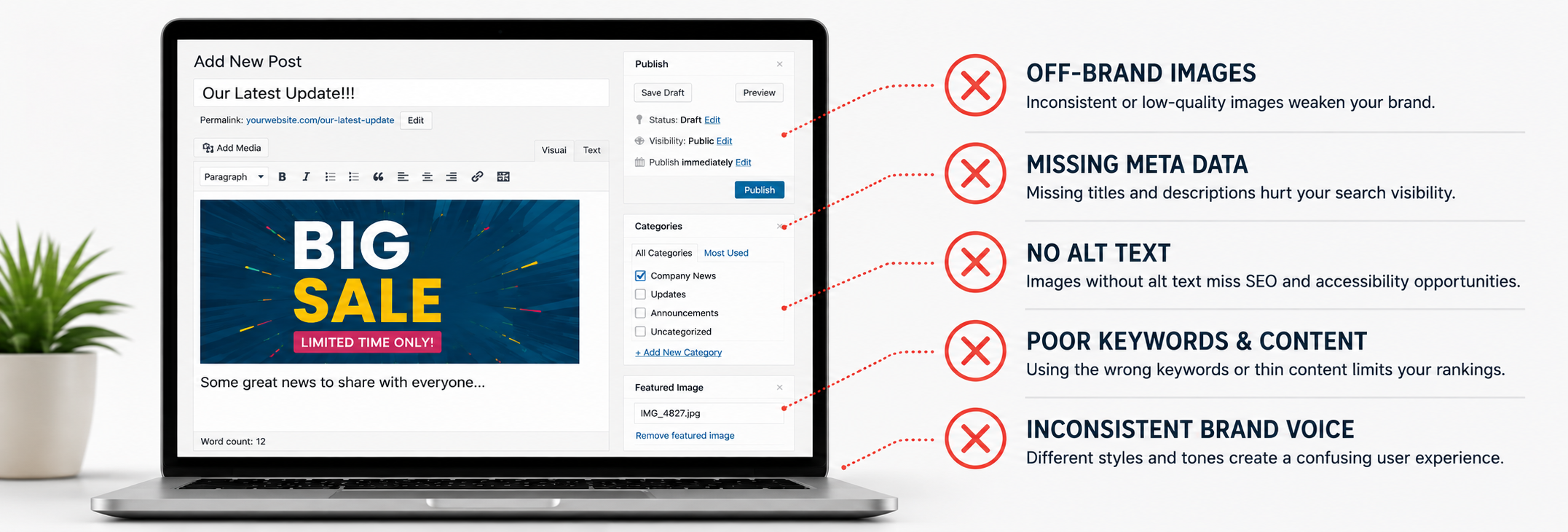
1. Uploading Images Without SEO-Friendly File Names
Many employees upload files called:
IMG_4827.jpg
Screenshot1.png
Final-Final-New.jpg
AI Image 7.jpg
Search engines cannot understand these file names.
A properly optimized image should be named something like:
calgary-commercial-roofing-project.jpg
utility-locating-equipment-calgary.jpg
hr-consulting-team-meeting.jpg
Every image is another opportunity to help search engines understand your website.
2. Missing Image Alt Text
Many users do not know that every image should contain descriptive alt text.
Alt text helps:
Search engines understand images
Accessibility for visually impaired users
Image search rankings
Overall SEO performance
Without alt text, valuable opportunities are lost.
3. No Meta Titles
Employees often publish pages without reviewing the SEO title.
The result:
Duplicate titles
Missing keywords
Poor search visibility
Weak click-through rates
A page title is one of the most important ranking factors on a website.
4. No Meta Descriptions
A meta description often becomes the sales pitch displayed in Google search results.
Many contributors leave this blank or allow software to generate random snippets.
That means potential customers may never see the best reasons to choose your company.
5. Off-Brand Images
One of the most common issues we see is employees selecting images based on personal preference rather than brand standards.
Examples include:
Different colour schemes
Inconsistent photography styles
Poor-quality stock photos
AI-generated images that do not match company branding
Outdated graphics
Over time, the website begins to look fragmented and unprofessional.
6. Ignoring Brand Voice
A website should sound like one company.
Instead, content often starts sounding like ten different people.
One blog may sound formal.
Another may sound casual.
Another may use technical jargon.
Another may be written like a sales brochure.
The result is an inconsistent customer experience.
7. Poor Keyword Selection
Many employees write content based on what they think customers search for.
Unfortunately, customers often use completely different language.
Professional marketers conduct keyword research before creating content.
Without research, blogs may target phrases that nobody actually searches.
8. Creating Duplicate Content
Multiple contributors frequently write about the same topics without realizing it.
This can lead to:
Duplicate pages
Competing blog articles
Keyword cannibalization
Confusing site structure
Search engines may struggle to determine which page should rank.
9. Breaking Website Formatting
Employees often:
Change font sizes
Use inconsistent headings
Insert oversized images
Create spacing issues
Copy content from Word documents
Over time, page consistency deteriorates.
10. Ignoring Mobile Users
Many contributors only review pages on desktop.
Yet most websites now receive more than half their traffic from mobile devices.
What looks good on a computer may look terrible on a phone.
11. Damaging User Experience
Marketing professionals consider:
Navigation
Calls to action
Page flow
Reading patterns
Conversion paths
Most employees simply focus on publishing information.
The difference is significant.
12. Publishing Unverified Information
Without a review process, inaccurate information can quickly appear online.
Examples include:
Incorrect pricing
Outdated services
Old staff information
Expired promotions
Incorrect contact details
Customers lose trust when they encounter inaccuracies.
13. Forgetting Internal Links
Internal links help:
Improve SEO
Increase page authority
Keep visitors engaged
Improve navigation
Most contributors never add them.
14. Not Understanding Search Intent
A customer searching:
“Calgary kitchen renovation cost”
has different needs than someone searching:
“Best kitchen renovation contractor Calgary”
Professional marketers understand these differences.
Most employees do not.
15. Publishing AI Content Without Editing
AI tools can help generate ideas and drafts.
However, publishing AI-generated content without review often creates:
Generic messaging
Factual errors
Repetitive language
Weak brand positioning
Human expertise is still required.
16. Ignoring Analytics
Professional marketers make decisions using data.
Most employees never review:
Search Console
Google Analytics
Conversion tracking
Heat maps
User behaviour
Without data, content decisions become guesswork.
17. Creating Inconsistent Calls to Action
Every page should guide visitors toward a next step.
Examples include:
Request a consultation
Download a guide
Contact us
Schedule a meeting
Without consistency, conversion rates suffer.
18. Accidentally Damaging SEO
Small mistakes can have major consequences:
Changing URLs
Deleting pages
Removing redirects
Breaking internal links
Overwriting metadata
These issues can impact rankings for months.
19. Uploading Large Images
Many contributors upload images directly from smartphones.
Large image files can:
Slow page speed
Increase bounce rates
Reduce SEO performance
Website speed matters.
20. Treating the Website Like a Bulletin Board
A website is not a place to post every announcement, event, update, or idea.
Every page should support:
Brand credibility
Search visibility
Lead generation
Customer education
Business goals
Random content often works against those objectives.
What Should Businesses Do Instead?
This does not mean employees should never contribute content.
In fact, subject matter experts are often the best source of ideas and industry knowledge.
The better approach is:
Allow employees to submit content ideas.
Have subject matter experts provide technical information.
Use a designated marketing lead to review content.
Follow brand standards.
Review SEO requirements before publishing.
Maintain approval workflows.
Limit publishing permissions.
Think of your website like your company’s storefront.
You would not give ten employees unrestricted authority to redesign your office lobby whenever they felt like it.
Your website deserves the same level of oversight.
Final Thoughts
The goal is not to limit employee involvement. The goal is to protect one of your company’s most valuable marketing assets.
The most successful websites are not built by giving everyone publishing access. They are built through a structured process that combines subject matter expertise with marketing strategy, SEO knowledge, brand consistency, and quality control.
If your website has been managed by multiple contributors over the years, you may be surprised by what a professional review uncovers. At SmartMarket Solutions, we become a member of your team. We can guide your staff through a structured website management process, provide training and oversight, or manage your website on your behalf. Either way, you can improve your website management process, protect your brand, strengthen your SEO performance, and ensure every website update supports your business goals.
Contact SmartMarket Solutions to learn how a more organized approach to website management can help your website perform better and reduce costly mistakes.
The Hidden Risks of Giving Multiple Employees Website Access
Your Website is More Complex Than You Realize Many business owners assume that giving multiple employees access to their website will... read more

Why Image File Names Matter More Than You Realize
One of the most overlooked SEO mistakes on business websites has nothing to do with keywords, backlinks, or website design. It’s... read more
Components That Make Up a Brand
A brand is a complex concept that encompasses various elements, both tangible and intangible. Here are the key components that make... read more
What are Keywords?
Keywords are specific words or phrases that people use when searching for information on search engines like Google, Bing, or... read more
Essential Skills Business Owners Should Possess
Running a successful business requires a diverse set of skills and expertise. From managing finances to building a strong team,... read more
What the Heck is Search Engine Marketing?
Search Engine Marketing (SEM) is a digital marketing strategy that increases search traffic to a website. Companies pay to have... read more
Setting Specific, Measurable Digital Marketing Goals
Specific, measurable, achievable, relevant, and time-bound (SMART) goals are crucial for effective digital marketing. They serve as the foundation for... read more
5 Important Features of Social Media Posts
Effective social media posts share several common features that help them engage with the audience. Here are five important features... read more